Childhood Gardening: Fostering Development and Environmental Awareness
Explore practical gardening projects for children, promoting skills, responsibility, and nature connection through planting and care.
Selecting Species and Materials for Children’s Horticultural Projects
Gardening offers children an invaluable space for exploration and learning, fostering a connection with the natural environment from an early age. This activity not only stimulates cognitive and motor development but also instills values of patience, responsibility, and respect for life. Involving youngsters in the creation and maintenance of a green space, whether a small plot or potted plants on a balcony, represents a unique opportunity to observe life cycles and understand the importance of sustainability. Through practical and accessible projects, their curiosity is sparked, laying the foundation for lasting environmental awareness.
Preparing the Environment: Keys to Starting a Children’s Project
The initial phase of any gardening project with children requires careful planning to ensure a successful and safe experience. Selecting appropriate elements is fundamental to maintaining interest and facilitating management by the young gardeners.
Selecting Child-Friendly Species and Materials
Implementing Home Seedbeds and Plant Life Cycles
Determining suitable plant species is crucial. Priority is given to fast-growing and easy-care plants that offer visible results quickly to maintain children’s motivation. Carrots, radishes, lettuce, and peas are excellent options due to their short cycle and the gratification of harvest. Flowers like marigolds or sunflowers, besides being showy, attract pollinators and enrich the space’s biodiversity. Aromatic herbs such as mint or oregano stimulate the senses and can be used in cooking. For tools, child-sized versions are recommended, made from durable and safe materials, like small shovels made of sturdy plastic or metal with rounded edges, lightweight watering cans, and gloves suited to their hands. The growing space can be as simple as recycled yogurt containers or cut plastic bottles, fostering creativity and recycling, a trend in urban agriculture that promotes resource reuse and waste reduction. Initiatives like creating vertical gardens with recycled materials are examples of innovation that can be easily adapted for children, maximizing space and applying circular economy principles.
Practical Projects: Ideas for Active Learning
Gardening for children becomes a significant learning experience when concrete projects are implemented that allow for active participation and direct observation of biological processes.
Implementing a Home Seedbed
Designing Sensory Gardens with an Emphasis on Aromatics
Establishing a seedbed is a fundamental project that illustrates the plant life cycle from its earliest stages. Ice cube trays, egg cartons, or small recycled containers can be used as starter cells. The process involves filling each compartment with substrate, placing one or two seeds per cell, and lightly covering with soil. It is essential to maintain constant moisture without waterlogging. Daily observation of germination, the development of the first leaves (cotyledons), and subsequent transplanting to a larger container provides a tangible understanding of botany. This activity reinforces patience and detailed observation, connecting with advancements in horticulture that emphasize controlled propagation and seed selection. The existence of community seed banks, such as those promoted by agricultural organizations, can serve as inspiration to explain the importance of conserving agricultural biodiversity.
Creating a Sensory Aromatic Garden
A sensory garden of aromatic herbs stimulates multiple senses. Plant selection is based on their textures (rosemary, lavender), aromas (mint, basil), and, in some cases, flavors (parsley, chives). Children can actively participate in planting, watering, and harvesting leaves for culinary use, linking gardening with gastronomy and culture. This direct interaction with plants encourages olfactory and tactile exploration, and allows for the identification of different species by their organoleptic characteristics. This approach aligns with the growing trend of permaculture, which seeks to design sustainable ecosystems where plants fulfill multiple functions, including sensory stimulation and the production of healthy food.
Maintenance and Care: Responsibility and Observation
Watering Techniques and Organic Pest Control Adapted
The long-term success of a children’s gardening project lies in the continuity of care, which teaches children about the responsibility and constant attention that nature requires.
Adapted Watering Techniques and Organic Pest Control
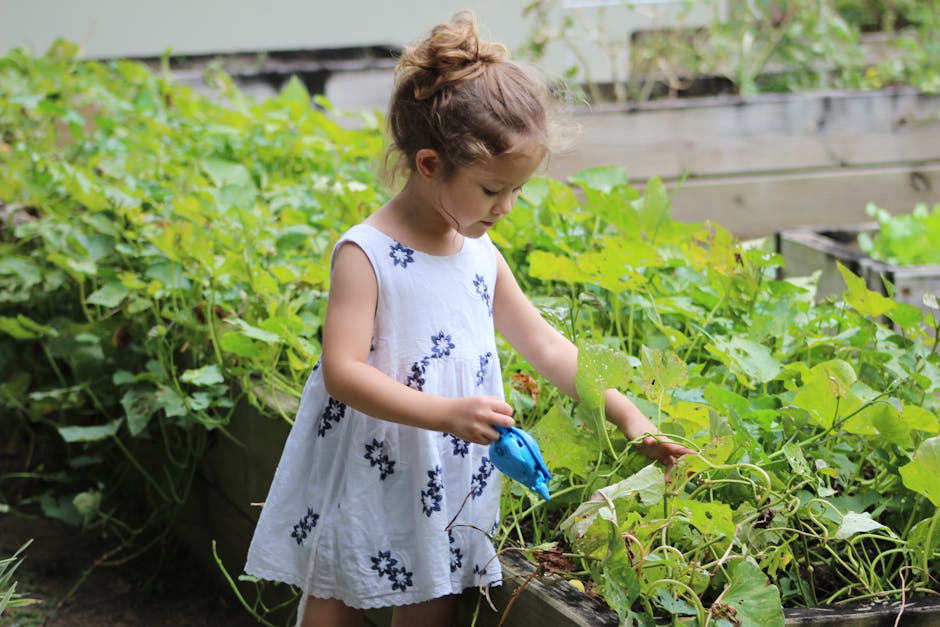
Watering is one of the most important tasks. Children are taught to observe soil moisture, avoiding both excess and lack of water. The use of small watering cans or spray bottles adapted to their strength allows them to participate actively. It can be explained how current technology, such as soil moisture sensors, helps optimize irrigation, although for them, direct observation is the primary method. Regarding pest control, organic and non-toxic methods are prioritized. Identifying beneficial insects (like ladybugs) and harmful ones, as well as applying homemade solutions like diluted potassium soap, are educational practices. Planting repellent species, such as marigolds or basil, near vegetables is an effective biological control strategy. These methods fall within the principles of regenerative agriculture, which aims to work in harmony with nature to maintain the health of the garden ecosystem without the use of harsh chemicals.
Gardening with children transcends mere recreational activity; it becomes an outdoor classroom that nourishes the spirit and mind. By participating in the plant life cycle, children develop a deep appreciation for the environment, cultivate patience and perseverance, and assume responsibilities that strengthen their self-esteem. These projects not only enrich their childhood but also sow the seeds of future nature guardians, capable of understanding and applying sustainable practices in their adult lives. Fostering this connection with the earth is an investment in a greener, more conscious future for the next generations.
Related Articles

Rio Grande Cherry: Adaptation, Management, and Potential
Explore edaphoclimatic requirements, water and nutrient management, biological control, and agro-industrial value of Eugenia involucrata for sustainable systems.

Solanum Lycopersicum: Soil Analysis, Genetics, and Agronomic Management for Modern Gardens
Enhance tomato cultivation through soil analysis, genetic selection, propagation, and sustainable water-nutrient management.

Low-Maintenance Gardens: Planning, Species, and Technologies for Sustainable Efficiency
Design strategies, native plant selection, and automation for functional, low-effort green spaces.
Low-Maintenance Garden Design: Sustainability, Biodiversity, and Efficiency
Optimize water and energy resources through adapted botanical selection, efficient irrigation, and biological design for a resilient ecosystem.